Sunday, February 20, 2011

You Know the Name--The Music of the Beatles, Pt. 1: Cross the Room and Join the Rest of the Band, Why Not


March 22, 1963


Wherein some randy soused gits go half-n-half and spin popular music wholly on its head.


The Beatles' crazed salad days defined the hoary term "pay your dues." The band was on the road virtually all of 1963, with two-a-days not uncommon, playing every willing and able club in the UK and even Sweden for a spell. The original plan for their debut release was a live recording of a gig at their hometown hub The Cavern, but originality can be overrated. On a rare day off, the fellas recorded Please Please Me (entirely live) in less than ten hours, with no one song requiring more than four takes to nail to satisfaction.


As their first recorded offering, Please Please Me showcases not just the band's deep debt to their myriad of influences through faithful yet distinctive cover songs, but also the burgeoning songwriting skills of plucky Messrs. McCartney and Lennon. (It was exceedingly rare in the 1960s for artists to actually write the songs they asked the world to fall in love with, even if only for a little while. So, perhaps spark one indicating the eventual conflagration.) A far better promise presented to the public all told than titling the record Off The Beatle Track, as producer/mentor/otherwise clear-thinking person George Martin wanted. You wanna know how to prematurely extinguish a cultural phenomenon, there's your 101 through 103 right there.


Still my favorite Beatles album cover ever. Don't they just look like the happiest harbingers of roiling sea change ever? Aw.


"I Saw Her Standing There"--Count off, blast off, Gerry and the Pacemakers fuck off. The most spectacular evocation of sweaty palms, shaggy locks and shimmying skirts. An EKG reading of rock and roll suitable for framing.


Early Beat-alls were dependent on the "woo!", which I have heard told it is in fact all about. To my mind, you will find no better "woo"s in their discography. These are honest, fraught exclamations, not just line filler.


"Well she was just seventeen/You know what I mean." Ain't no wink nudge pedo, this is naught but a like-aged horndog appreciating burgeoning femininity. So just walk on, duck.


The most common, overarching complaint against the early albums in stereo is that they simply rob the songs of their punch. It is glaring here. The vocal panning is egregiously shite. Microbats will navigate these songs easily. Play "I Saw Her Standing There" in mono, and it clumps together like the tastiest fudge, while stereo segregates the sounds so drastically as to render focused listening pointless. Those claps in stereo sound like a group of grannies trying to get the feeling back in their hands.


"Misery"--Entirely too peppy for a song titled such, and really, it isn't that peppy at all. I'm not expecting Kafka-esque doomsaying, but this just sounds mildly in the dumps but trying to play it up so they can score some happy pills.

"Anna (Go to Him)"--The first two lines rhyme "girl" with "girl." Damn Art Alexander, lyrics are hard. I get it though. Love makes the world go 'round, nobody wants to be alone, the duality of existence, yes yes it's all quite devastating in its elaborate simplicity. The Beatles are just getting off on the release of expression, no one expected theories or philosophies. Luckily, the riff is a real pincer and the choral "aaahhh"s are cute in the way a really stoic bunny is.


"I love you so/But if he loves you mo'."


Mmm, yes. Next slide, please.


"Chains"--In the great debate over Carole King and Joni Mitchell that exists primarily in my own head, King wins. Barely. Both women are responsible for some of the most timeless earworms of the 20th century. Both recorded albums regarded in certain circles outside of my own head as touchstones for women of a certain generation and singer/songwriters in general. And personally, I think Joni has the stronger catalog. But Carole King was once upon a time the musical half of one of music's most legendary songwriting duos. With then-husband Gerry Goffin, she provided aspiring performers some instant hits that frequently exceeded their expected expiration date. Members of the British Invasion bands of the 60s took to these records (particularly those performed by black artists) and came to idolize the American couple responsible for the joy and inspiration.


Goffin and King had no more famous devotees than John and Paul. In a 1963 profile feature for the NME, they were singled out as the boys favorite songwriters, and McCartney specifically would state in interviews that they aspired to reach the bar set by the Brill Buildings finest. Joni Mitchell certainly has her acolytes...Plant and Page, Prince, just to pinpoint the most prominent. But Carole King was one half of the songwriting team that arguably the greatest most celebrated songwriting team in rock and roll lore wanted to be like when they grew up.


Gah, all this talk about winning, I sound like Billy Corgan! Art doesn't keep score. Besides, both Carole and Joni at different times had sex with James Taylor. Who released his debut album in 1968 on Apple Records. The label founded by the Beatles. See? No one wins.


"Boys"--Wow, I didn't actually talk about that last song at all. Well, no such worries here.


This Shirelles classic was actually tailor-made for drummers to sing, thereby shattering the conventional wisdom that no way can you keep a beat and a tune simultaneously. A harmless li'l trifle, and enough fun to fill a good-sized water gun, but it still sounds too slow to my ears. Definitely would have benefited from consumption of dodgy stimulants prior to pressing "record."


"Ask Me Why"--Attacked by the deadly woo chain! Ask me why I'm listening to this. I'm scoobied. This is like watching a toddler learn to walk. Historically fascinating!


"Please Please Me"--The first single, penned 100% by Lennon, with a spiritual assist from onetime tourmate Roy Orbison. Considered an all-time classic by a lot of fans who aren't me. It's fine. The guitar gives good push. The tri-vocals are super. And the "come on/come on" always puts me in mind of "I Like It Like That" by the Dave Clark Five, which is a better song.


Apparently this is the first pop song about oral sex. I'm pretty sure at least three music journalists have used this scandalous bit of history as the jump off point for overwritten essays on sexuality in popular music. Ooh, you raunchy ragamuffins. There is no way this is a better track than "From Me to You." But...I'm getting ahead of myself. (It looks remarkably life-like. Badum-pish.)


Notable difference in mono and stereo: listen for Lennon's vocal flub during the last verse. It's supposed to be "I know you never even try, girl" but he starts with "Why do you," realizes his error, and just trails off to the melody.

"Love Me Do"--This was the smash that broke the Beatles in America, hitting the top 5 in the charts in 1964 and inciting a mania of some sort.


Written (primarily) by Paul McCartney in his living room. While he was skipping school. Fuck off. Honestly. I wrote the shittiest poetry fathomable through glassy eyes whenever I played hooky, and this fuckin' guy crafts a timeless ode to the most timeless desire engrained in humanity. (Lennon did the middle eight, a drop into D that gives the song a brief, needed sonic gravity.)


Vocal harmonies are all over Please Please Me, I mean it's what the Beatles fucking did, but nothing else matches the synergy here. It's easy, even corny, I mean what does "love me do" even mean? In sentiment it's very hand-holdy and shy-smiley, the polar opposite of the song before it, which may as well be called "Blow Me Do," really. The harmonica throughout fits snug with the easy rider drums, especially at the end of the former's non-showy solo when it drops out and a simple beat crashes before the vocals come back in. I bet this was the first song Animal from the Muppets learned on his kit.


"PS I Love You"--The first draft of a love letter to Buddy Holly, as signed by one smitten baby-faced Macca. He would go on to craft more intimate and intricate missives of devotion to an even greater selection of paramours in the future, and all for the better.


"Baby Its You"--John couldn't help but feel a twinge of guilt whenever the group played in front of black artists or fans in those early days, as their set was heavy on covers of songs originally performed by the marginalized minorities. He felt, in a way, fake. His gang of honkys could never hope to match the soul and passion, all borne of true suffering, agony and longing, that made the original compositions positively ache through the speakers. Lennon's shame and doubt is understandable, but in actuality, the stereotype of the awkward, soul-handicapped white singer is not always accurate. In the case of "Baby It's You," however, it's on the money like an ugly white guy's face.


"Do You Want to Know a Secret?"--John wrote this for George. The secret is, "I'm in love with you." Oh goddamnit. Guys, there's other emotions out there. Like anger towards Burt Convy, although really it was your fault for trusting him.


I confess to being rather taken by the enchanting scale here. Could have done more with it.


"A Taste of Honey"--Oh Beatles. Let's never again do this thing that has here been done.


"There's a Place"--A tutorial in spike sharpening, in just under two minutes.


"Twist and Shout"--Back to the racial discussion, 'cause that's never much the threat that one, eh? While "Baby It's You" was lackluster and bland, "Twist and Shout" absolutely throttles the senses and hurtles the listener right there to the Cavern Club, watching lads in suits set the groundwork for actual revolution. Yes Virginia, white musicians can sometimes do a song even better...I'm thinking the Diamonds' rendition of "Little Darlin'" and Rare Earth's version of "Get Ready," which I tell you, when sex in outer space happens, it better happen to that song.


You can actually hear Lennon's throat lining tear. It must have sucked for him, but it rocks for the rest of us. That's giving yourself to the music.


Of course, Ferris Bueller had to fuck it up again for whitey. Horns? Please please you.


You Know the Name--The Music of the Beatles, Introduction

"Do you ever write about anything but Sonic Youth?"

Yes. SY-based material makes up 'round 6% of my total scribbles. Admittedly, it's received 98% of all the attention.

"Would you ever do a full discography review for your second-favorite band?"

Oh yeah. I can tell you right now I'll absolutely do that.

"Cool. Look forward to it."

Yeah, cool.

*remembers who her second-favorite band is*

Ah, shit.

---------------------------------------------------------

The series title is unchallenging, yet undeniably true; no band has inspired more volumes detailing more inane minutiae than PaulJohnGeorgeRingo. Even people who avowedly loathe the Beatles know more about them than many bands whose music they enjoy, thanks to cultural osmosis. So, no ostentatious preamble. This is a song by song review of every Beatles album, in mono and stereo. For the sake of my sanity and yours, I will not separate each album into reviews of each version. Where the differences are that noticeable, I will make my remarks. Please Please Me is first up, shortly.

Tuesday, January 25, 2011

Update

Thanks to computer repair issues, the Beatles discography review will be up in February. Just a flesh wound, then.

Tuesday, November 16, 2010

Nerd Geek Dork

Recent employment shan't halt my plans to have the Beatles discog reviews up starting early next year. This overview will consider the albums in the Mono and Stereo box sets, although I won't be setting it like, here's a review of A Hard Day's Night in Mono, now I'll do it again for Stereo. That would be incredibly annoying to write, and thus even more vexing to read. I actually like my readers, so I won't be doing that. I'll be delineating within each album entry the differences between the recordings, as well as my usual heart-stopping impressions on the songs themselves.

Sunday, October 31, 2010

The Greatest Peanuts Sundays--10 to 1

10. 10/24/99

For the record--Charlie Brown didn't kick the football. Schulz would never let him. But Rerun takes so much crap from Lucy, it's nice to see him turn the tables and drive her crazy.

9. 9/22/96


A sublime indictment of general attorney uselessness.

8. 6/30/63

We didn't often see Lucy's self-doubt manifest itself via harsh self-admonishments; usually it came through in her harassment of the other kids. We often see Linus' out-sized heart, and most brilliantly here.

7. 8/8/82

Charles Schulz was a proud supporter of women's athletics, and look no further for proof than this Sunday strip. Look also at all the names lost to history! This strip is just as relevant now as then, sadly.

6. 2/24/72

You may recognize this as the show-stealer in Be My Valentine, Charlie Brown. Yes, Charles Schulz put much of his first wife into Lucy Van Pelt, but these extreme moments, full of rage and sorrow and loathing, are the dregs of his soul darkening the paper.

"The tortures of a memory of a lost love"--what a beautifully worded and structured phrase--sends the poor girl into a paroxysm, sending the not-as-poor Schroeder out of the frame and taking out his piano as not-quite collateral damage. When faced with such meticulous fury, one can only look on in awe.

5. 3/9/69


Charles Schulz singled this out as one of his favorite Sundays, and clearly I agree. It could have been printed with no text and still worked just as well. What is it Linus wants to hand off? Worms? Coconut candies? It remains unknown, which is why it scares Snoopy so intensely. When he reluctantly receives the mystery booty, he can't help but want to pass it along. Schulz drew wonderfully expressive faces throughout all the phases of Peanuts, but nothing tops the diabolical mischief that twists along Snoopy's visage as his failure-face of an owner approaches.

4. 2/18/62

Snoopy just wants some friends; it's not his fault he takes so keenly to cold, inert precipitation creations. He is right to be wary, but awwww...life is risk and love is risk, so death must be like Sorry! or something, and that's not as fun as the game of global domination, so lean into that snowman and feel the love and HE DID IT AGAIN! Never has an "Augh!" torn at the heart so viciously! Poor Snoopy.

All relationships, good bad or indifferent, end. Some quite unceremoniously. All we can hope for, indeed the very finest outcome we can dream for, is to have a carrot left over at the end.

3. 11/5/72

A beginning panel of Peppermint Patty and Charlie Brown frolicking on a fall day leads into an unusually thoughtful Patty busting out one of the grandest similes my mind has ever registered. "Life is like a bracelet" is just a beautiful thought. Leave it to self-absorbed Charlie Brown to not recognize the moment this young girl is trying to share with him. His loss. Charlie Brown's life is like a bracelet, all right...the ones made of candy.

2. 3/18/53


The second time ever we see Snoopy dance, and it's the dooziest. Such style, such suave, such grace, such power, such cute. (A real-life dog like this would be a viral sensation; take that, Ninja Brown Bear.) The joke is decent enough (and gotta love the double exclamation points over Snoopy's head near the end) but really this one is all about the visuals. The whole gang, save Shermy, bears witness to this magnificent display, adding to the festive feel of the strip, causing it to virtually leap out at you with a sense of communal joy.

1. 9/22/63


Lucy's psychiatrists booth is the favorite Peanuts gag of Matt Groening, but he just adores Lucy in general. The concept totally fits in with the mercenary nature of many children, as does the circular logic in much of the advice she dispenses.

What she tells Charlie Brown here, however, is the truest thing Charles Schulz ever put in his comic strip. There is a great curiosity among many people to look at the lives of others not to enhance their perspective on their own life, but to grow envious and resentful and wonder why. Lucy puts it rather plainly (and loudly): Do and die, blockhead. That's ours.

Saturday, October 30, 2010

The Greatest Peanuts Sundays--20 to 11

20. 2/17/74


The only thing Peanuts characters do more than pine or AUGH is sigh. What makes this strip special is not the Scripture quote, because Schulz dropped Biblical wisdom so frequently that a pastor named Robert Short wrote a best-selling book called The Gospel According To Peanuts. It's the novelty of this quote (which further proves the expansive intelligence of Charles Schulz). There's a couple handfuls of lines from the Old and New Testaments used by and/or known to most people, from devout believers to rampaging atheists. This ain't one of them.

19. 10/20/63


In 1962, in the case of Engel vs. Vitale, the Supreme Court ruled it unconstitutional for state officials to compose official school prayer and require it to be recited by students in United States public schools. A year later, Charles Schulz composed a nearly text-free masterpiece tackling the issue of school prayer that appeared in papers on Sunday. Naturally.

The reaction to this Sunday was enormous, with the pro- and anti-school prayer factions confident that Schulz had drawn the perfect encapsulation of their feelings on the issue. Mind you, anyone claiming they saw their point of view validated in Sally's mega-paranoid behavior just revealed themselves to be not quite bright. The neutrality of the strip was another flare of Schulzian genius, meaning impressionable, emotional readers would twist it to fit their beliefs, but when dared to pinpoint the moment in the strip that they could see the cartoonists solidarity with them...they couldn't do it.

"I don't believe in school prayer. I think it's total nonsense." - Charles Schulz, interviewed in The Comics Journal in 1998.

In case you were wondering.

18. 2/8/82


Silly rebellion is the best of all. Anarchy isn't funny, and that's why it'll never work. Snoopy dancing is always funny. Snoopy singing? Funnier than Redd Foxx doing an impression of Slappy White proposing marriage to a bottle of Thunderbird while an alley dog knocks over a small child getting out of its mothers car mere feet away.

17. 9/18/94


Gotta love origin stories. Spike in the desert was one of the more average Peanuts runs, and to my eyes this was far and away the best strip featuring Snoopy's emaciated brother and his cactus buddies. We all need someone to unburden ourselves upon, even if they have shallow roots.

Snoopy's whole clan is down with the bunnies; if Spike ever told his brother this same tale, Snoop would probably weep and quaff a root beer in memory of the departed.

16. 1/30/83


Creepy nightmare fuel. Wonder if Schulz ever had a similar dream. Wonder what this dream meant?

It meant he was asleep!

15. 10/21/73


A clinic in intriguing penmanship, right from the title panel featuring the mean faces of Snoopy and Peppermint Patty snarling at each other from each end of the world's largest football. It's goin' down.

I love the strips where Schulz threw curveballs at the reader; here, he not only draws a tackle between Patty and Snoopy, he surrounds it with words. Most hilarious: SOUND OF GLASS-BREAKING. He coulda just put SHATTER! but he didn't, 'cause it's not as funny as SOUND OF GLASS-BREAKING.

Charles Schulz spoke to me in the oddest ways sometimes.

14. 2/16/58


Hoary punchline...but not really so hoary at the time. Reminiscent of a sequence in A Charlie Brown Christmas, which is another reason I rate it so highly. It's art that evokes pungent, positive memories. So is Peanuts art? Yessir.

(Note: where is Snoopy's collar?)

13. 5/21/72


Peppermint Patty's simple question (although it isn't, really) inspires a fabulous Charlie Brown story on the folly of memory. The text bubbles are packed sick, the twist is ruefully humorous, and Snoopy not only gets in a super cool ending line, he also has his eyes closed throughout the strip. Snoopy plus shut lids equals COOLER THAN US. If it were possible for humans to function as well as Snoopy seems to with closed peepers, you'd never catch sight of my baby blues again.

12. 10/11/70


Another example of weaving scripture effortlessly within art. The joke is hilarious, but chilling. Lucy's remark about being "unable to accept the finality of the Lord's judgment" makes me think of the disappointment, sadness and anger Charles Schulz would feel almost thirty years later, when his body began to break down on him, robbing him of thinking and inking up any more strips.

11. 9/22/57


Not the first of the football gags, but the best. Lucy's sheer glee swiping away the ball, sure, but there's also the out-of-control comedy in Charlie Brown's incredulous "SHE DID IT AGAIN!" whilst flying up in the air.

Poor Chuck, always a sucker for a woman's reassuring words. I don't imagine he was really sold at all by Lucy's attempt at a sincere face, however; she looked like a pelican imitating an alligator.

Friday, October 29, 2010

The Greatest Peanuts Strips--10 to 1

10. 10/29/59

And so was born a legend. Linus, sick of his peers' insincere toadying up to a big, ostensibly jolly fat fella, announces his belief in something called "The Great Pumpkin," which one can only imagine is the most gigantic, most benevolent and beneficent fruit in the world.

The Great Pumpkin was one of Charles Schulz' most original and brilliant story ideas. It was translated to the li'l screen with smashing success (said special aired twice this week on national television) and has become part of the pop culture vernacular. There's just something about a kid refusing to buy into the crap parents have fed their kids forever and creating his own mythology to pour heart and soul into, built on sincerity above all.

9. 10/21/87


When you see Patty and Marcie seated in the theater, some bickering is sure to follow. But here, Patty is actually delighted (rather than confused) by what's transpiring on stage, resulting in a satisfied smile rather than a furrowed brow on not just her face but Marcie's as well. Patty's last words mirror precisely my feelings while reading these strips.

8. 2/27/52


Bits and pieces of the artist come out in their work. It is inevitable, unless of course the creator is a complete sociopath (in which case they're probably country music songwriters). From the very beginning of Peanuts Charles Schulz did not hesitate to channel his irritations into the minds and mouths of these li'l folks. In this beauty from '52, a self-absorbed Violet rambles on to a clearly disgusted Charlie Brown about the film festival that played in her brain last night. While many people are fascinated by the world of dreams, seeking deeper meaning in the succession of images and sounds, others are content to shrug them off as biological futzery. Perhaps it is his determination to make dreams come true during waking hours that has Chuck so skeptical and annoyed? The moral here is that the unexamined subconscious life is entirely worth living.

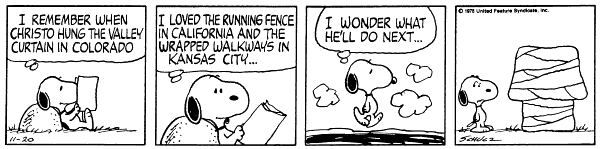
7. 11/20/78


There was a mutual admiration society going on with Schulz and Christo, two of the more daring artists of their time. My favorite single panel in Peanuts history is the final one here. Snoopy's fourth-wall-crashing reaction, the visual of Christo having worked his magic...flawless. Looks great on a shirt too.

Twenty-five years after the strip's debut (and three years after the death of Charles Schulz), Christo wrapped the doghouse for real. Viewing this masterpiece was one of the highlights of my 2009 trip to the Schulz Museum, right behind the recreation of Schulz' personal studio. Which actually made me tear up.

6. 1/10/52


Charles Schulz served in the U.S. Army during World War II, an experience he spoke of with pride. His admiration for the military and those who served was apparent throughout his work, be it in the seventeen strips where Snoopy pays tribute to (and quaffs some root beers with) Bill Mauldin or in any of the 1990s strips honoring D-Day.

Before he felt comfortable citing the war and wartime, however, Schulz gave a glimpse into one very specific, haunting incident that occurred in May 1945, as he and the other members of his task force traversed Bavaria. Several of the men in the group gathered some pieces for their personal collection and they moved on. Sergeant Schulz playfully aimed a recently acquired pistol at an army medic across the street, the red cross on his helmet making him a tempting play-target. Schulz then fired a shot, having not checked to see if the firearm had any live rounds in the chamber.

It did.

The shot grazed one of the medics cheeks, but did not cause any serious harm. (Army soldiers unwittingly shooting themselves or their comrades with fancy new "enemy" weaponry was not uncommon at all during the war.) Schulz did speak of the incident in one recorded interview and could not help but reflect how the world would have changed but for mere inches. The hard-working, dedicated Sergeant who dreamed of making the comics page his life's work may have lost it all with one ill-advised squeeze of the trigger.

Knowing of this incident makes the strip at number 6 a complete breath-thief. It may seem so silly and random to suddenly have Charlie Brown scream out the report of a child's fake pistol, then apologize for it, but to Charles Schulz there was nothing silly or random about what happened that day in May. It's a man who forgets no slight, no shame, who is still learning to live with regrets even as he makes manifest his destiny.

5. 10/16/81


For proof of Charlie Brown's acceptance of himself as an undeniable failure face...here you go. Life may get better for him, but not by that much, and not for too long, and it was probably an accident anyway.

(Slight issue I have here. Patty and Chuck are chatting at the neighborhood wall, then at the last square, the wall is gone. Did they start walking away, then Charlie Brown suddenly thought, hey, I got the perfect person for you to talk to right here? I kinda wish Schulz had made this a Sunday, with that exact scenario playing out.)

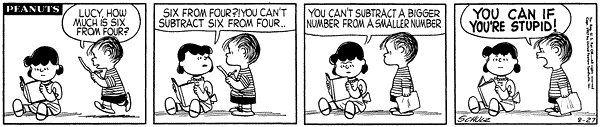
4. 8/27/57


Math! Ugh! Or, rather, AUGH!

Linus defends his right to be dumb as rocks (with one of the most gut-bustingly hilarious lines Schulz ever conjured up). Which is quite cute when you're a kid, but when you get older, such behavior should be discontinued and discouraged lest you end up enraptured with the mystery of magnetism. I distinctly remember as a child wondering why there was a "highest" and a "lowest" but no "mediumest." Later I realized there is no such thing as the "most middle."


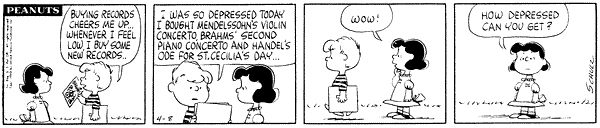
3. 4/8/63


You can rest assured that the composers and pieces Schroeder mentions were not selected haphazardly. Charles Schulz put the utmost care into the words he animated his drawings with.

This strip is so damn relateable that multiple music blogs, sites and forums have utilized it, always affectionately. The first panel itself is Thurston Moore's existence in a square.

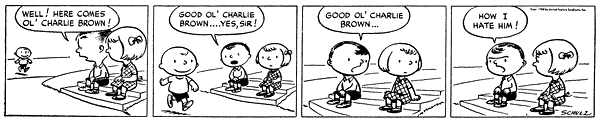
2. 10/2/50


The first Peanuts strip ever, and it's a knockout blow. Right away the reader checking out this new-fangled kiddy comic sees that this will not be the standard milquetoast fare that saturates the daily paper. This is the inexplicably resentful and two-faced nature of humanity illustrated through the soundless voices of young children. "Good ol' Charlie Brown. How I hate him!"

Just why would Shermy feel that way? Just why did Charles Schulz regard himself as a "blah" type of person with a forgettable face? Why would he question if he would be of any value to anyone without the acclaim brought about by his talent? Why would existential panic seize him in the night?

Some people just don't like the Charlie Browns of this world, the ones that don't know when to quit, or maybe even why they should quit. They believe in love. They treat people decently and are satisfied with doing the best they can, despite knowing that "winning is the only thing" will always be more oft-quoted than Vince Lombardi's later lamentation retracting the very statement that made him a legend in leadership. They feel with every inch of vessel inside their body. They are frayed ends and exposed viscera. They don't care about the dreams you have when you're asleep. They do, however, care about everything else.

Did Charles Schulz hate Charlie Brown by putting so much of his agony into this poor blockhead?

No. Charles Schulz loved Charlie Brown. That's why he became the unceremonious dumping ground for the neuroses that plagued Schulz. It made him infinitely more interesting and funny. I think deep down Schulz wanted Chuck to boot the football, but he just couldn't make it happen because...then what? Also...not funny.

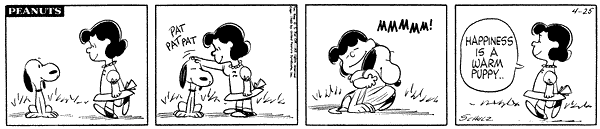
1. 4/25/60


"Happiness Is a Warm Puppy" catapulted Peanuts into the pop culture stratosphere. A book of the same name that featured various scenarios showing what the Peanuts kids considered the state of being happy became the fifth best-selling fiction book of the 1960s. Peanuts posters and pennants dominated dorm rooms. Schoolchildren bombarded Schulz' office with their own "Happiness Is..." drawings. "Happiness Is a Warm ______" became a popular phrase, with no end to what you could use to fill in the blank. A firearms periodical titled one of their articles "Happiness Is a Warm Gun," which so intrigued John Lennon that he used it for one of the most beloved Beatles songs ever.

It is, of course, a simple strip. Lucy walks over to Snoopy, pats him on the head, snuggles up to him and walks away with a smile, uttering the phrase that launched an empire. The genius of it is Schulz' decision to make Lucy the one who says this heartwarming sentence. She is easily the most irascible of the Peanuts children, yet even she needs to feel secure and loved and warm and happy. She's a fussbudget supreme, and Snoopy isn't even her dog, and sometimes she wants to pound him, but at that moment that dog represents the peace that everyone needs to find and nestle into.

There is no hatred. No doubting. No arguing. No clever reference. There is love here, and it's requited. It's so requited your teeth could hurt. Just happiness. Elusive for so many hours of our lives, but resplendent when realized. So much of Peanuts delineated in pinpoint detail the suffering that plagues us. This strip recognized that it is not all despair. For what it represented to the world of Peanuts as both a work of art and a business franchise, it is my favorite daily.